
Is Your CPU Bottlenecking Your GPU? Here's How to Actually Check

What "Bottlenecking" Actually Means
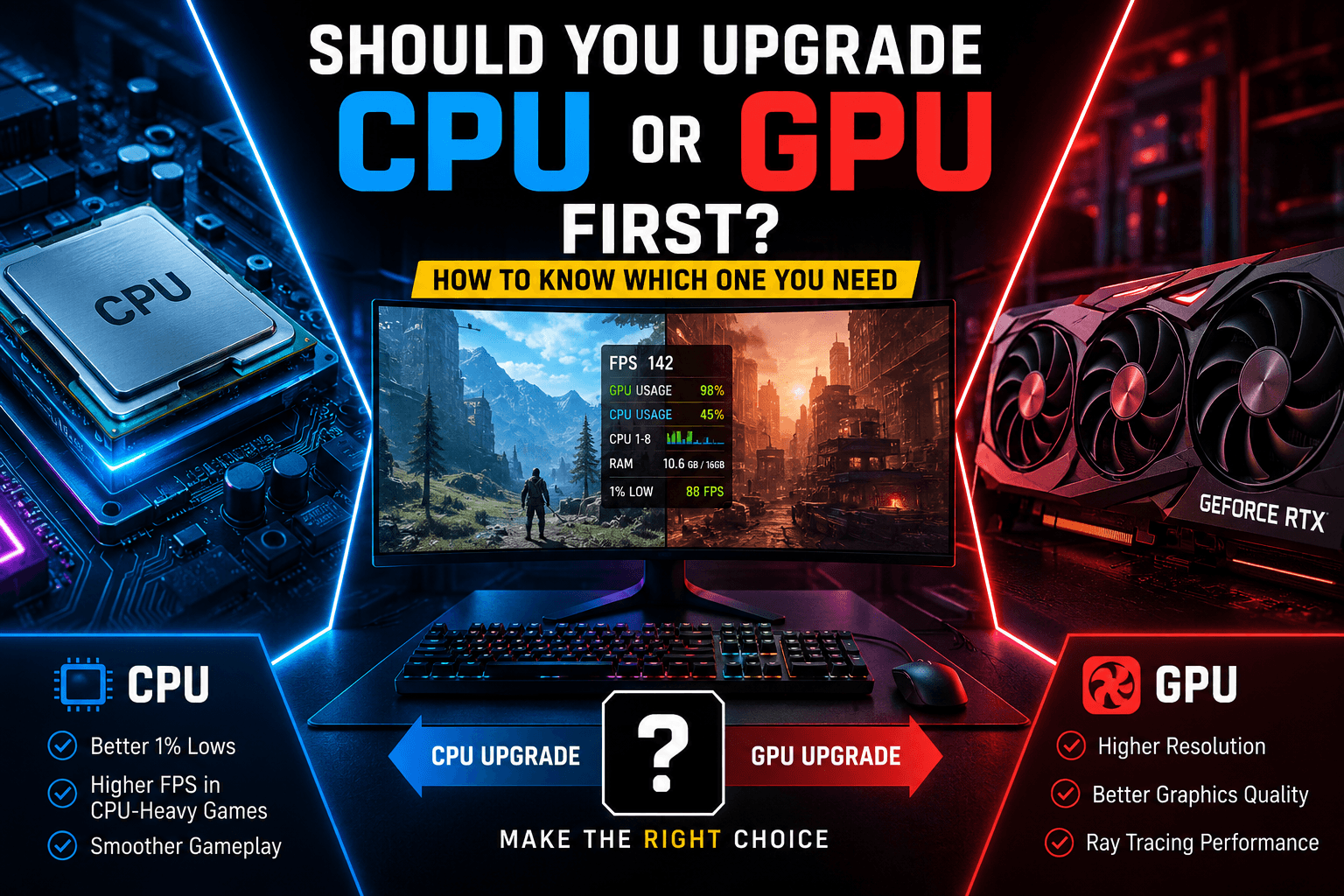
A bottleneck happens when one part of your system can't keep up with another, so the faster part sits around waiting instead of working at full capacity. With a CPU and GPU pairing, it means your graphics card is capable of rendering more frames than your processor can feed it instructions for.
Picture a busy restaurant kitchen. The chef (your GPU) can plate dishes incredibly fast, but if the person taking orders (your CPU) can only relay one ticket every ten seconds, it doesn't matter how fast the chef is capable of cooking. The kitchen's overall output is capped by the slowest link.
This is exactly why a brand new GPU sometimes barely outperforms your old one in certain games. Your CPU was already the limiting factor, and swapping the graphics card didn't change that.
You can browse more hardware breakdowns like this one on the FixPlay homepage as you build out your understanding of how each component actually affects performance.
How to Check If You're Actually Bottlenecked
You don't need expensive software to get a reasonably accurate read on this. Here's the method I use on every build.
Step 1: Open Task Manager while gaming. Press Ctrl+Shift+Esc, click the Performance tab, and keep it visible (or use an in-game overlay) while you play. Watch both GPU usage and CPU usage.
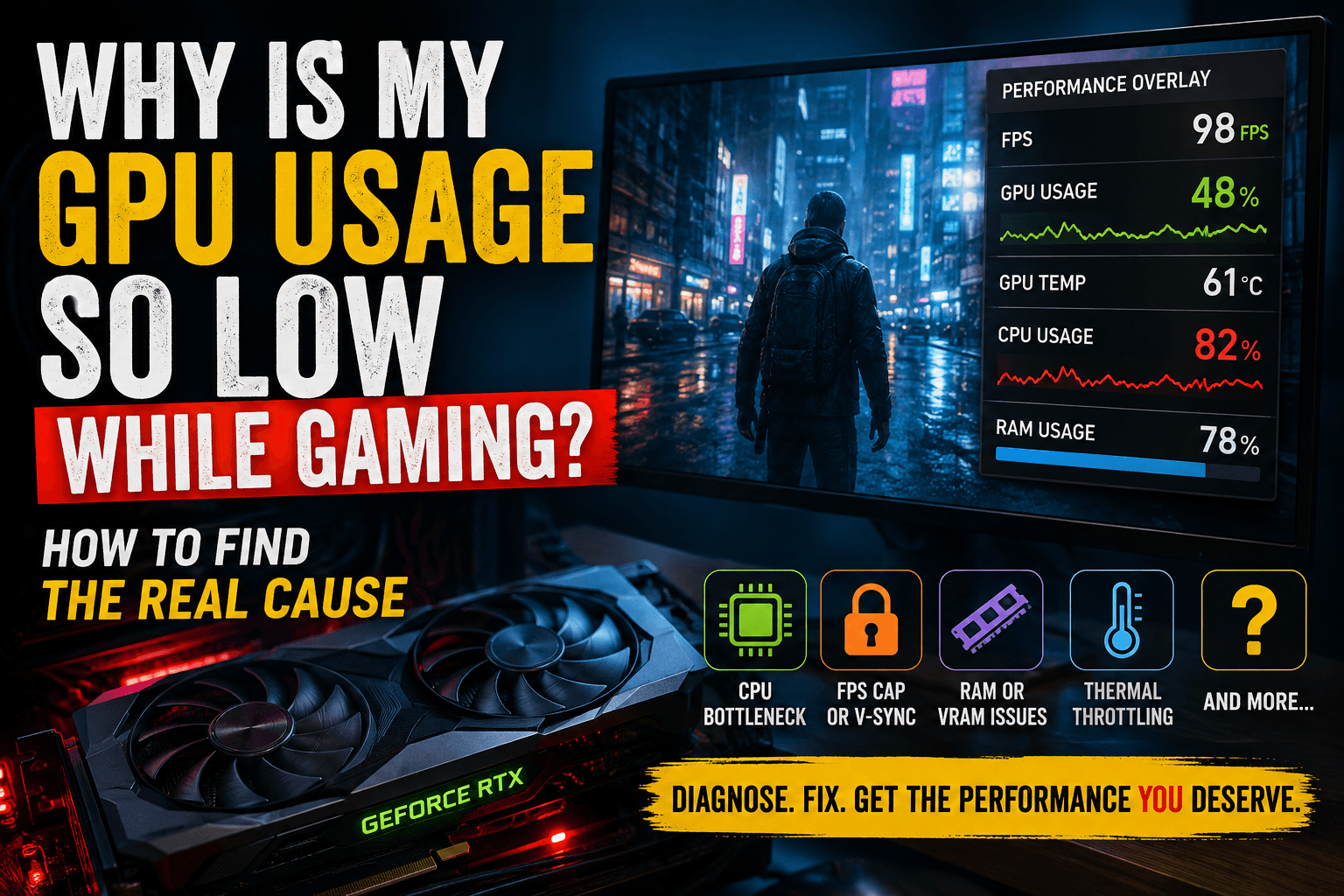
Step 2: Read the usage percentages. If GPU usage sits at 95 to 100 percent consistently, your graphics card is working hardest, which is actually the healthy scenario. If GPU usage drops noticeably below that, say 60 to 80 percent, while one or two CPU cores spike toward 100 percent, your CPU is likely the limiting factor.
Step 3: Use MSI Afterburner with RivaTuner for a clearer picture. It's free, and the overlay shows both GPU and CPU load in real time without alt-tabbing. I'd genuinely recommend this over Task Manager once you're past the basic check, since it updates faster and doesn't interrupt gameplay.
Step 4: Compare across a few different games. A CPU bottleneck in one title doesn't always mean it exists everywhere. Strategy and simulation games (Cities: Skylines, Total War) tend to lean hard on the CPU, while open-world and graphically dense games (Cyberpunk 2077, Red Dead Redemption 2) usually lean on the GPU instead.
Step 5: Check per-core usage, not just the overall average. This is the part most people miss. Task Manager's headline CPU number is an average across every core, so a CPU sitting at "45 percent overall" can still be the bottleneck if two specific cores are pinned at 100 percent while the rest sit mostly idle. A lot of games still don't spread work evenly across every core, so that average number can hide the real problem. Right-click the CPU graph in Task Manager and switch to "Logical processors" to see each core individually.
Is Some Bottleneck Normal? Reading the Numbers Right
Here's something a lot of articles gloss over: some degree of bottleneck is completely normal, and chasing a perfect zero percent is a waste of time and money.
Personally, I think the bottleneck percentage calculators floating around the internet are oversold. They hand you a tidy number, but that number shifts dramatically depending on the game, resolution, and even what's running in the background. A more useful way to think about it: if your GPU usage stays above 90 percent in the games you actually play, you're in good shape. Below that consistently is worth investigating further.
A 5 to 10 percent gap rarely deserves panic. It becomes a real problem when you're consistently seeing 70 percent GPU usage or lower in demanding titles, especially if the frame rate feels choppy rather than just numerically lower than expected.
Resolution Changes Everything
This is the part most guides skip, and it's arguably the most important piece of the puzzle.
The higher your resolution, the more work shifts onto the GPU and the less the CPU matters. At 1080p, your CPU has to prepare far more frames per second for the GPU to render, so weaker processors show their limits quickly. At 1440p and especially 4K, the GPU carries so much more per-frame work that CPU bottlenecks often shrink or disappear entirely, even with older processors.
This is why someone can read that a certain CPU "bottlenecks" a certain GPU and be completely wrong for their own setup. A pairing that bottlenecks hard at 1080p in a competitive shooter might show almost no difference at 4K in a graphically heavy single-player game. Context matters more than the raw spec sheet.
I ran into this myself with an older six-core CPU paired against a mid-range GPU upgrade. At 1080p in a fast-paced shooter, GPU usage sat around 75 percent, a clear CPU-side limit. Switching the exact same setup to 1440p in a single-player, visually heavy title, GPU usage climbed to 98 percent with no changes to the CPU at all. Same computer, same day, completely different bottleneck situation. Resolution alone flipped the outcome.
Fixing It: What Actually Works
If you've confirmed a real bottleneck, here's what moves the needle, roughly in the order I'd try things.
Lower CPU-dependent settings, not just graphics settings. Draw distance, NPC density, and physics simulation load the CPU more than they load the GPU. Turning these down can free up headroom without hurting visual quality much.
Close background processes. Discord overlays, browser tabs, and streaming software all eat into CPU cycles. I've seen a genuinely surprising fps jump from just closing a stray browser window with too many tabs open.
Update chipset and GPU drivers. Outdated drivers can create artificial bottlenecks that have nothing to do with your hardware's real capability.
Consider a CPU upgrade only after ruling out the above. If you're still seeing low GPU usage in the games you actually play after trying everything else, and you're on an older CPU generation, that's when an upgrade makes sense. Not before.
Common Mistakes to Avoid
Judging bottleneck from a single benchmark video. Your system, background apps, and settings are never identical to a reviewer's test bench. Treat it as a rough guide, not gospel.
Chasing zero percent bottleneck. As covered above, this isn't realistic or necessary, and it leads people to overspend on CPU upgrades they didn't need.
Ignoring RAM speed. A CPU bottleneck can sometimes actually be a RAM bottleneck in disguise, especially on AMD platforms where memory speed directly affects the infinity fabric.
Assuming the newest CPU always fixes it. Game engine optimization matters just as much as raw CPU power. Some newer CPUs barely help in poorly optimized titles.
Wrapping Up
A CPU bottleneck isn't a defect, and it isn't always something you need to fix. Check your GPU usage while gaming, compare it across a couple of titles, and factor in your resolution before assuming your processor is the problem.
Most of the time, small adjustments (closing background apps, tweaking CPU-heavy settings, updating drivers) close more of the gap than people expect. Save the upgrade money for when you've actually confirmed it's needed.
If you're planning your next build or upgrade, keep exploring FixPlay's hardware guides to make sure every component you choose actually complements the rest of your rig.

Written by
Kashif
Founder & Lead Editor, FixPlay
Kashif is the founder and lead editor at FixPlay, covering PC hardware, console gaming, and breaking industry news since 2021. He builds and benchmarks his own test rigs before writing any hardware guide, and has covered major releases including GTA 6, Elden Ring, and Call of Duty season updates. His GPU and settings guides are based on hands-on testing, not spec-sheet guesses.
View all posts by KashifRelated Posts
2 Comments
Hi, Nice Information
Thanks